AI SaaS Platform
AI SaaS for Social-Media Content With Stripe & Credit System
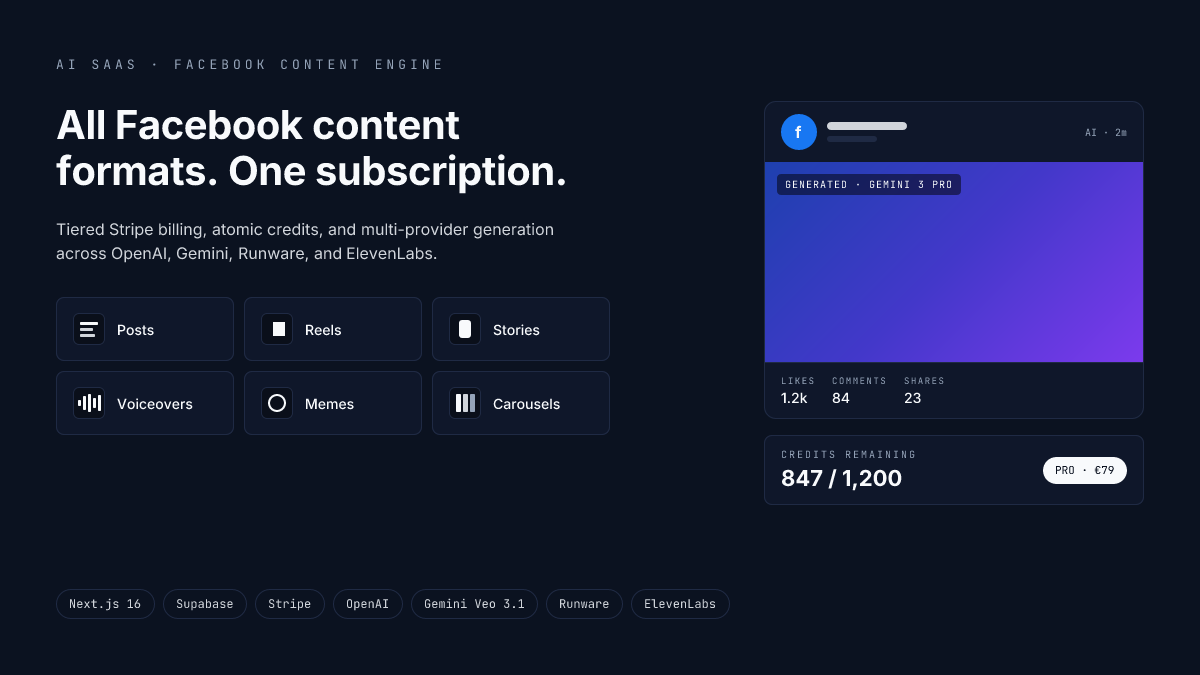
Production-ready SaaS for social media creators: 20+ AI generators (images, reels, videos, voiceovers), tiered Stripe subscriptions, atomic credit system. Multi-provider orchestration across OpenAI, Gemini, Runware, and ElevenLabs.
Challenge
Social media creators juggle five to ten tools daily — one for image generation, another for video, captions, scheduling. Switching is slow, expensive, and breaks creative flow. No single product unified the workflow under a consistent subscription model with margin-aware cost economics.
Solution
A unified AI SaaS where creators generate images, reels, videos, voiceovers, memes, and post copy in one place — paid via three subscription tiers with credit-based usage. Multi-provider orchestration with fallback logic, plus atomic credit deduction at the Postgres function level that rules out race conditions even with parallel jobs.
Results
✓20+ AI generators in one product — images, reels, videos, voiceovers, memes, posts
✓Stripe subscription infrastructure with three tiers, trial system, monthly reset
✓Atomic credit deduction at the Postgres function level — no race conditions
✓40-75% margin modeled across every AI provider in the cost matrix
✓Async job pipeline with external worker and webhook callbacks
✓596 commits, 57+ API routes, 30+ user-facing pages — live with paying users
Technologies Used: Next.js 16 · React 19 · TypeScript · Supabase · Stripe · OpenAI · Gemini · Runware · ElevenLabs · Tailwind CSS
Voice AI Platform
Real-Time Voice AI for Medical Communication Training
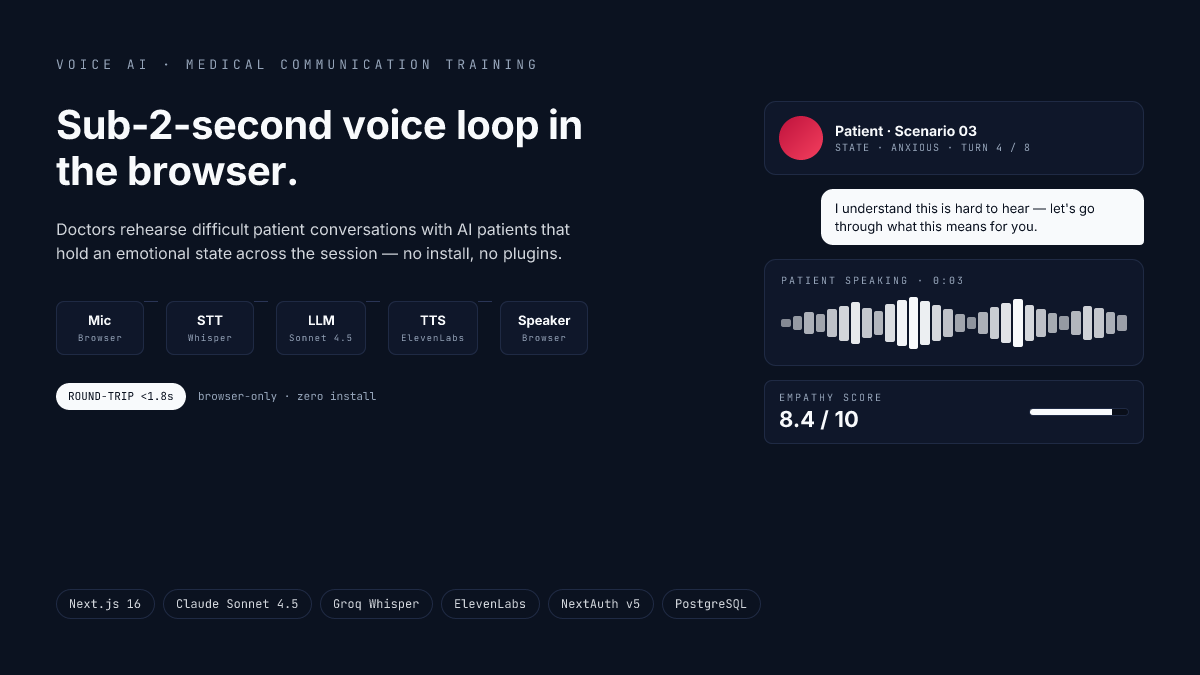
A browser-based voice AI training tool where doctors rehearse difficult patient conversations with emotionally consistent AI patients. Speech recognition, dialogue, and synthesis round-trip in under two seconds — no installs.
Challenge
Medical communication skills — breaking bad news, talking with vaccine-hesitant parents, navigating non-compliance — traditionally require booked actors and coaches. They don't scale and produce no objective feedback. Existing digital options are either text-based (no real speaking pressure) or require a native app install, often impossible on hospital workstations.
Solution
A browser-only training platform where trainees speak with AI patients that hold an emotional state across the entire session and react consistently. Browser audio capture, Whisper STT, Claude Sonnet dialogue, and ElevenLabs TTS combined into a streaming pipeline. After each session, a second AI model evaluates the full transcript and returns structured feedback with empathy score, clarity, and concrete improvement points.
Results
✓Sub-2-second round trip from user speaking to AI replying out loud
✓Three voice providers orchestrated in one synchronous low-latency pipeline
✓Emotionally consistent AI patients across multi-turn conversations
✓Structured feedback after each session — empathy score, turning-point sentences, next steps
✓Per-provider token tracking — exact margin per session computable
✓Live in production with active medical users
Technologies Used: Next.js 16 · React 19 · TypeScript · Anthropic Claude · Groq Whisper · ElevenLabs · PostgreSQL · NextAuth v5
AI Coaching with Long-Term Memory
AI Coaching Platform With Real Long-Term Memory
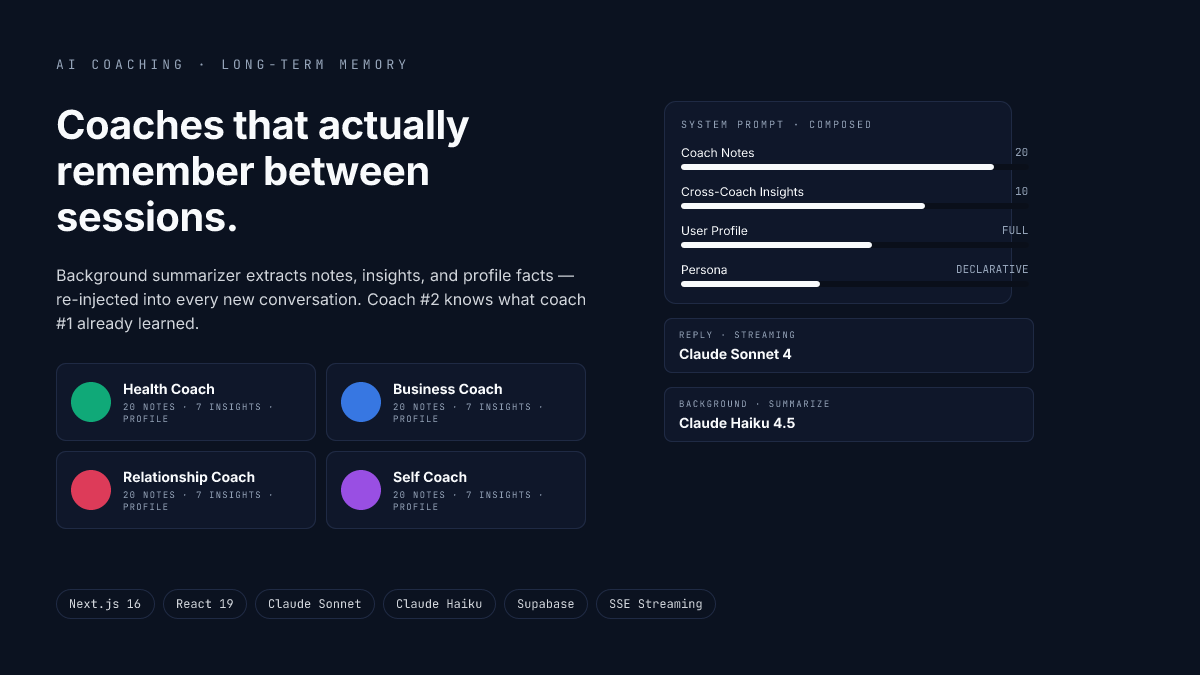
Four AI coaches (health, business, relationship, self-coaching) that remember the user across sessions. A background summarizer extracts notes, insights, and profile facts and injects them into later conversations — coach #2 knows what coach #1 already learned.
Challenge
Off-the-shelf chatbots start every conversation from zero. For a coaching product — where the entire value is 'the coach knows me' — that's the difference between a useful product and a toy. Building real long-term memory the right way is hard: you need to extract structured signal from messy conversation, store it without ballooning the context window, and re-inject the relevant pieces at the right moment.
Solution
A four-persona platform where every coach builds a persistent memory across all conversations — and shares relevant insights with the other coaches. Replies stream in real time from Claude Sonnet while a cheaper Haiku model continuously extracts structured notes, cross-coach insights, and a per-user profile in the background. On each new message, the last 20 notes, 10 cross-coach insights, and the coach profile are composed into the system prompt.
Results
✓Two-tier model architecture — Sonnet for replies, Haiku for background summaries
✓Structured notes in five categories per coach (strengths, weaknesses, patterns, goals, open topics)
✓Cross-coach insights with explicit source provenance
✓Token-by-token streaming via Server-Sent Events
✓Clean five-table Supabase data model with cascading deletes
✓Per-message cost explicitly attributable per model tier
Technologies Used: Next.js 16 · React 19 · TypeScript · Anthropic Claude Sonnet · Anthropic Claude Haiku · Supabase · PostgreSQL · Server-Sent Events · Tailwind CSS v4
Pinterest Multi-Account Automation
Multi-Account Pinterest Automation Platform
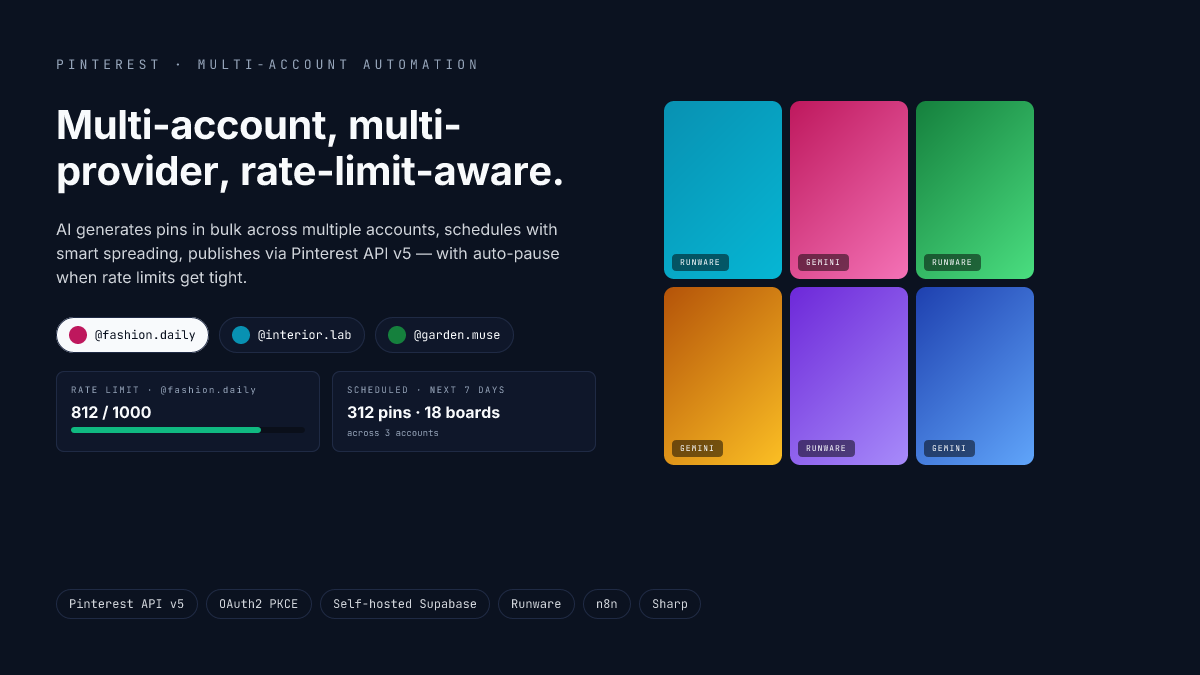
Production tool for agencies and publishers running multiple Pinterest accounts. AI generates pins (image + title + description) in bulk, schedules them across boards with smart spreading, and publishes via the official Pinterest API — rate-limit-aware with auto-pause.
Challenge
Pinterest growth across multiple accounts is a manual nightmare: log in, switch account, design a pin, write a title, write a description, pick a board, schedule — repeat 30 times. Existing tools either handle multiple accounts badly, run into Pinterest's aggressive rate limits, or stop at scheduling and never actually publish.
Solution
A multi-tenant platform that orchestrates multiple Pinterest accounts from a single UI. Bulk AI pin generation across three image providers (Runware, OpenAI, Gemini) behind a unified brand-style abstraction. Smart scheduling with maximum spread for same-URL pins, exponential backoff on 429s, and publishing via Pinterest API v5 with OAuth2 PKCE and automated token refresh. Self-hosted Supabase on owned infrastructure — full data control without per-row pricing.
Results
✓Multi-account architecture validated in production
✓Three image providers swappable behind a unified brand-style abstraction
✓Per-account rate-limit tracking with auto-pause below threshold
✓OAuth2 PKCE with encrypted token storage and refresh cron
✓End-to-end: extraction, generation, validation, scheduling, publishing, reconciliation
✓250+ commits, 63 API routes, 15 user-facing pages
Technologies Used: Next.js · TypeScript · Pinterest API v5 · OAuth 2.0 PKCE · Self-hosted Supabase · PostgreSQL · Runware · OpenAI · Gemini · n8n · Sharp · Satori
Content Pipeline
Multi-Site AI Content Pipeline for WordPress
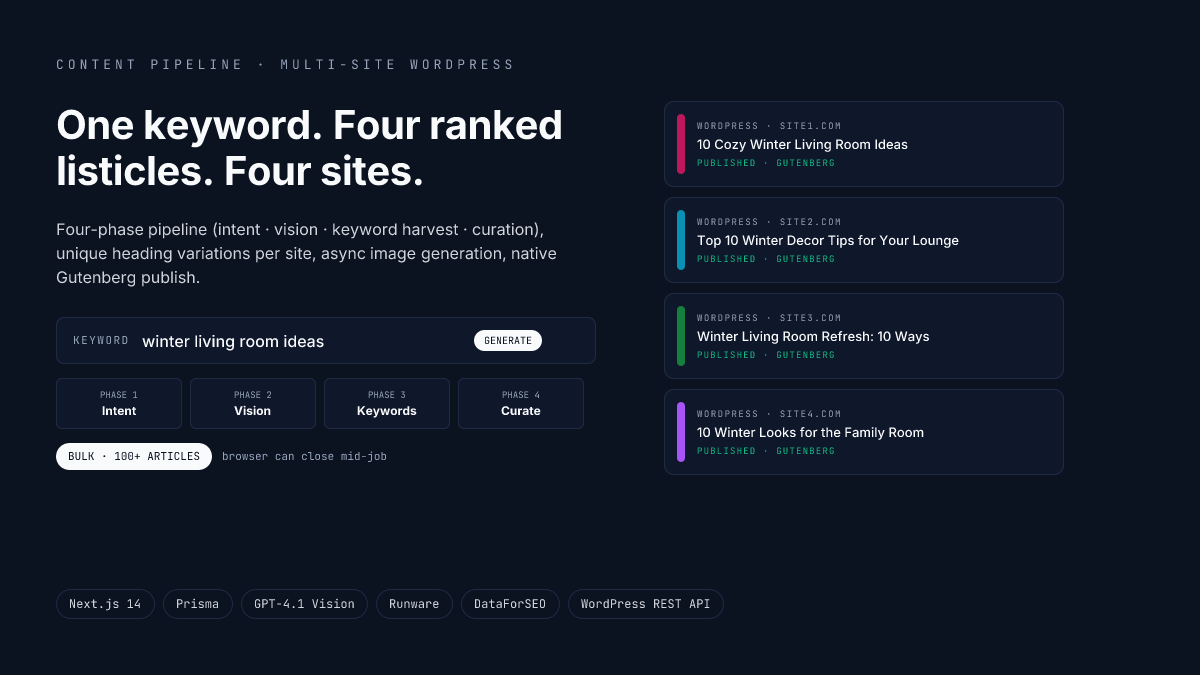
End-to-end content engine: one keyword becomes four SEO-optimized listicle articles across four WordPress sites — with unique titles, heading variations, AI-generated images, and direct publish via the WP REST API. Bulk mode chains 100+ articles sequentially.
Challenge
Content teams running multiple niche WordPress sites have the same problem: every site needs unique articles around the same keywords, but writing four versions of 'Top 10 Living Room Ideas' by hand is brutal. Existing AI tools either produce duplicate content (Google penalizes), miss the visual search-intent layer, or stop at draft — someone still has to log in and paste it into WordPress.
Solution
A four-phase pipeline: intent classification, Pinterest vision analysis via DataForSEO screenshot, structured keyword enrichment through a custom Pinspector service, final curation. Unique heading variations per site avoid duplicate content. Async image pipeline via Runware with webhook callbacks. Publishing as native Gutenberg blocks directly through the WP REST API. Bulk mode chains 100+ articles sequentially — the browser can close mid-job.
Results
✓Four-phase outline pipeline with graceful degradation when providers fail
✓Multi-site, multi-language (seven locales), multi-template
✓Async image pipeline with webhook callbacks and automatic alt text generation
✓Native Gutenberg block output — no editor breakage
✓Self-chaining bulk pipeline for 100+ articles per job
✓270+ commits, 77 API routes, 22 user-facing pages
Technologies Used: Next.js 14 · TypeScript · PostgreSQL · Prisma · OpenAI GPT-4.1 · Runware · DataForSEO · WordPress REST API · Upstash QStash
AI-Powered Content Portal
AI Recipe Portal With Native Pinterest Distribution
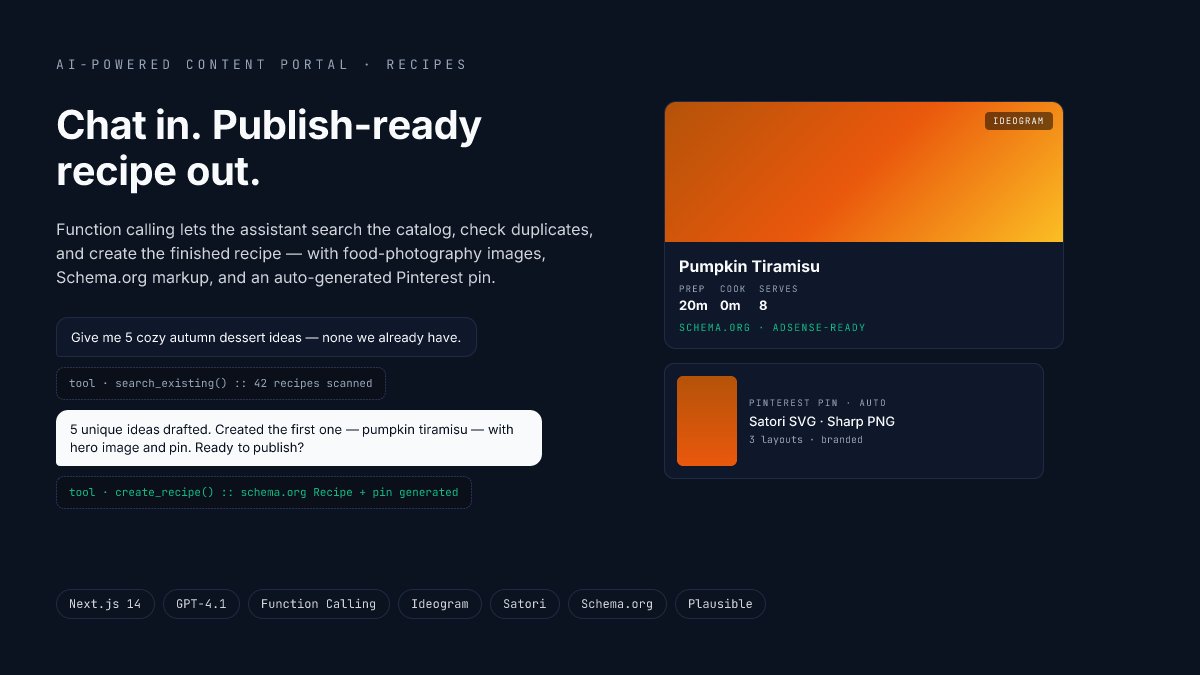
Live, monetized recipe portal: editor chats with an AI assistant that searches the catalog, checks for duplicates, generates ideas, and ships publish-ready recipes with food-photography imagery and Pinterest pins via function calling.
Challenge
Running a content site solo is a treadmill. Every recipe needs research (does it already exist?), structured data (Schema.org Recipe for rich results), AdSense-friendly markup, branded Pinterest pins, and a fast performant public site. Most CMSs give you the editor and call it done — the operator glues a stack of separate AI tools, image services, and pin generators together by hand.
Solution
A live portal where the editor chats with a built-in AI assistant — function calling lets the assistant search, validate, generate ideas, and create the finished recipe. Ideogram for food-photography imagery, Sharp and Satori for branded Pinterest pins, ISR with React cache for read-heavy public pages, full Schema.org markup, geo-blocking and bot detection at the middleware layer, AdSense in production, self-hosted Plausible for privacy-friendly analytics.
Results
✓AI co-author via chat instead of forms — function calling produces finished recipes
✓Automatic Pinterest pin generation per recipe (Satori SVG → Sharp PNG)
✓Schema.org Recipe + BreadcrumbList + Organization markup for rich results
✓ISR + React cache — recipe pages cost almost nothing to serve
✓Self-hosted Plausible analytics + AdSense in production
✓230+ commits, 47 API routes, 26 user-facing pages
Technologies Used: Next.js 14 · TypeScript · OpenAI GPT-4.1 · Function Calling · Ideogram · Sharp · Satori · Supabase · Schema.org · Plausible Analytics
AI Agent Infrastructure
AI-Agent Operations Stack — Production Engineering From Anywhere
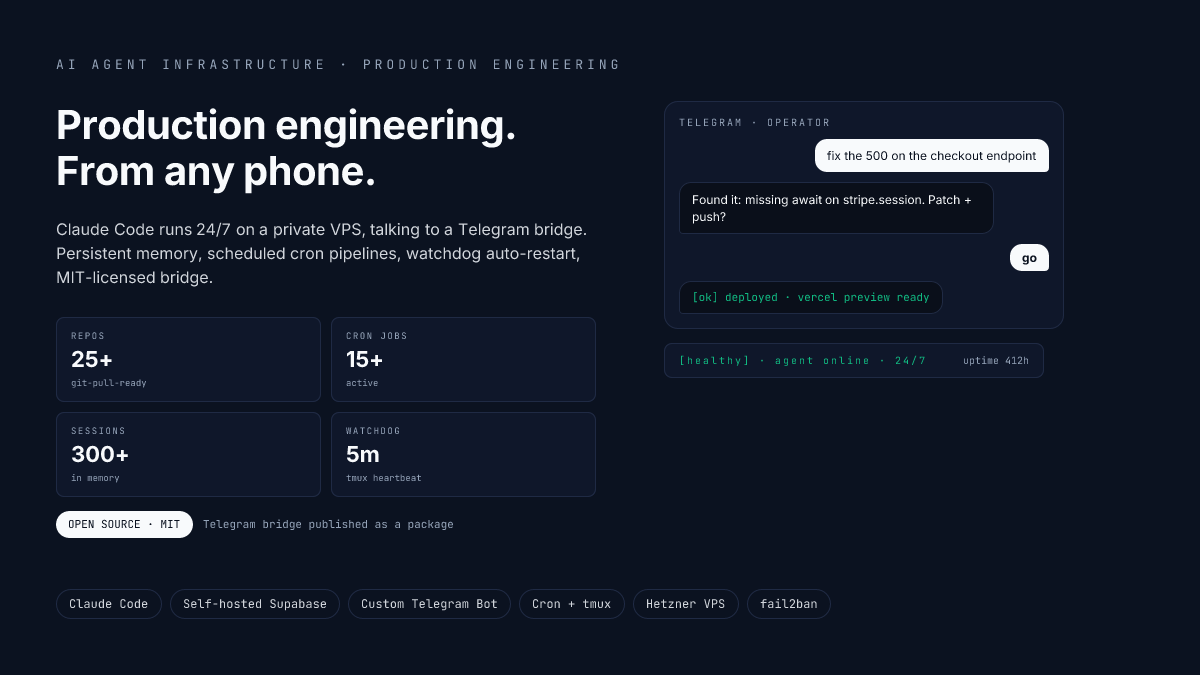
Self-hosted AI agent stack: Claude Code runs 24/7 on a private server with 25+ production repos cloned, persistent memory across sessions, scheduled cron pipelines, and a custom Telegram interface for commands and production fixes from any phone.
Challenge
Engineering operations don't scale by adding humans — they scale through leverage per engineer. The current problem: AI agents like Claude Code are powerful, but running them productively requires a stack that doesn't exist out of the box — persistent memory across sessions, scheduled jobs, a way to ship production fixes from a phone, clean secrets handling without leaks, and an audit trail that's actually greppable. Most teams give up after a week or end up with a Frankenstein of bash scripts.
Solution
A production-grade AI-engineering operations platform. Claude Code runs 24/7 on a self-hosted VPS with 25+ production repos. A custom Telegram bridge enables commands, progress updates, and production fixes from anywhere — same conversation context whether at a desk or on the go. A persistent memory layer (Supabase-backed, Haiku-summarized) gives the agent continuity across sessions. 15+ cron pipelines deliver daily reports, Vercel error webhooks land with severity tagging directly in chat, a watchdog keeps the agent alive even through crashes. Open-source Telegram bridge under MIT license.
Results
✓25+ production repos on one machine, all git-pull-ready
✓15+ active cron pipelines (reports, monitoring, sync, watchdog)
✓Three-tier memory search: quick summaries → detail digests → full session logs
✓Watchdog with tmux heartbeat — auto-restart on agent crash
✓Vercel error webhook → severity tagging → Telegram alert with one-tap context
✓Open-source Telegram bridge (MIT) as verifiable proof
Technologies Used: Claude Code · Anthropic Claude API · Self-hosted Supabase · PostgreSQL · Custom Telegram Bot · Cron + tmux · Hetzner VPS · Plausible Analytics · n8n · fail2ban